Quote of the week

“ No steam or gas ever drives anything until it is confined.
No Niagara is ever turned into light and power until it is tunnelled.
No life ever grows until it is focused, dedicated, disciplined. ”
— Harry Emerson Fosdick ( Living Under Tension )

Everything Simplified

Reforms Brought by Mustafa Kamal in Turkey

Leave a Comment

In : , ,

Mustafa Kamal Pasha
Image Source: Wikipedia
Mustafa Kamal Atatürk was the founder and the first president of the Republic of Turkey. He liberated the Turkish nation not only from the external enemies but from the internal enemies as well. He pushed back the Allies and abolished the Sultanate. Similarly, his reforms made Turkey a thoroughly progressive democratic republic. This article accounts for his efforts in a piled-up manner.

History

After the WWI, Turkey was under the control of Allied forces. The Sultan (of Ottoman Empire) and old liberals were merely puppets whose strings were controlled by the occupation forces. The Sultan considered it the best option for Turkey to collaborate with the conquerors.
The Sultan sent Mustafa Kamal to Anatolia as a Governer General in order to crush the rebellion led by Kiyazim Karabekar. However, Mustafa Kamal had other plans. As soon as he reached Anatolia, he met Ali Faut, the commander of a small army corps, and sketched out a resistance plan. It was decided that they should form a National Army. The summary of this meeting can be described as:
As the Sultan and the Central Government are in enemy hands, we must set up some temporary government in Anatolia.
Remarkable efforts were put up for this cause. Leading Patriots hid or escaped into Anatolia, where they made straight for Ankara to join Mustafa Kamal. There on the 23rd of April, 1920 the revolutionary Turkish Grand National Assembly met with Mustafa Kamal as President.
Don't miss: Who Was Bolivar?

Reforms
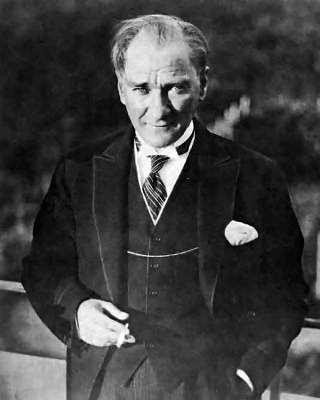
Mustafa Kamal
Image Source: Wikipedia
After abolishing the Khilafat, Mustafa Kamal took over as the first President of new Turkey. He brought many revolutionary reforms in the Turkish system for which he is known as "Atatürk" meaning Father of the Turks. Some of his efforts are described below:

Removal of Illiteracy

Before Mustafa Kamal's accession to power, state education was unknown to the country. He took the gigantic task of educating the masses as well as training the teachers. The first step in revoming illiteracy was to simplify the "script" by replacing the old (Arabic) script with the Roman script. He himself visited towns and villages, chalk in hand, teaching how to use the new script.

Empowering Women

On assuming power, Mustafa Kamal decided to liberate women by abolishing veil. He was well aware of the importance of educated women for a nation. He encouraged women to educate themselves for their better future. He emphasized the need for women to play their role in country's progress working side by side with men folks.

Change in Dresses

Atatürk abolished wearing fez which was Greek in origin. However, he made it compulsory to wear Western hats. This reform was necessary to remove all the traces of the past slavery during the days of Ottoman Sultanate.

Purification of Language

The first Turkish President set a committee to simplify and purify Turkish language which was a mixture of Arabic, Persian and original Turkish words. The committe's task was to replace the Arabic and Persian words with original Turkish words. Moreover, he prohibited the use to title "Pasha" and hence, every man became "bay" and every woman became "bayan".

Industrial and Economic Development

Under Mustafa Kamal, the industrial and economic development of Turkey was so rapid that it achieved, in few years, that much progress which took the west 150 years to achieve. To give idea of the progress, one has to take notice of some of the facts and figures.
  1. In 1919, Turkey had only one railway, almost no modern standard roads and 150 factories. But in 1933, the figure rose to 2000 with large lengths of high standard transport facilities.
  2. The banking system was organized and the public debt was reduced to one-tenth of its former size.
Don't miss: Napoleon Bonaparte

Read More

How did Navies Originate?

Leave a Comment

In : ,

Navies
The first navies were created when the armed men of a tribe or town went to sea in large ships they had, in order to give a battle to their enemies and raid territory from the sea. The ships used were ordinary fishing or commercial ships. Later on, ships were especially designed for purposes of war.
Do you know?
     Originally, the navy of a country meant all of its ships, whether used for war, carrying of merchandise or fishing.
At the time of ancient Greeks and Romans, the very first long ship was built for speed in war, instead of round ones to carry merchandise. When the Persians threatened to attack Athens in 483 B.C., the Greeks increased their navy from fifty to one hundred long ships. By the end of the fifth century B.C., this fleet of long ships had increased to 300 and later even to 360, which makes it quite a navy! In times of peace, these warships were kept on slips and undercover in sheds.
The most ancient warships were many-oared galleys, each requiring a  great number of rowers. These great rowing galleys were used to ram other ships or as a mean of boarding the enemy ships.
In both the ancient Greek and Roman navies, there were many similarities to the organization of a modern navy. The Greeks had a captain, a sailing master, a number of petty officers, seamen and oarsmen, and soldiers or marines. The Romans always had a body of soldiers, called the classici, who were especially assigned to service in the navy.
Today, of course, a navy is a very complicated organization with dozens of types of ships and units organized to maintain them. Pakistan Navy is one of the best navies in the world.

Read More

How did the United Nations Begin?

1 comment

In : , , ,

United Nations
 During the World war II, the Allied nations referred to themselves as the 'United Nation'.In 1942, the allied nations agreed that they would not make any separate peace agreements with Germany.
In a Potsdam conference in 1945 which really laid the ground for the foundation of the United nations to make precautionary  measures to prevent future conflict and also set out procedures for the prosecution of Nazi war criminals.the first agreement of Potsdam conference was signed by Twenty-seven countries in 1945, as the war gets over the United nations formally came into existence.In the initial there was a membership of fifty countries.
     The United nations (UN) is led by a powerful Security Council.The United Nations had enough power that they can intervene in international disputes that might lead to conflict.Today the UN is too strong yet enough developed that they are involved in many economic aid programmes all around the world.
Did you know?
    In the early 1945 the Allied leaders met in Yalta in Crimea to decide on the post-war shape of the world. Churchill, Roosevelt and Stalin decided on how Germany was to be split up once the war was won.

Read More

Origins of Names of Some Popular Animals

Leave a Comment

In : , , ,

Many of us love animals, some make them their best friends. That's great, these lovely creatures do deserve to be loved. As for their names, not all the English names of animals came about the same way. Some are just the English word for a name that already existed in another language while others are combinations of words that describe the animal. Let's consider the names of some animals and see how they originated.

Origins of Animal Names
 A Fox and a Cat
     Bull comes from the Anglo-Saxon belkan, which meant to "roar". Similarly, deer was originally deor in Anglo-Saxon, and meant "a wild animal".
When we call a cat, a puss, it goes back to the Egyptians. They called a cat pasht, meaning "the moon", because cats were active at night. This became shortened to pas, and that's how we got puss.
Hippopotamus is the Greek for "river horse". Hippos meant "horse", and potamos meant "river". Rhinoceros is a Latin term derived from two Greek words. Rinos mean the "nose", and the keras, was a "horn", and the rhinoceros has a horn on its nose!
Leopard comes from the Latin leopardus, which meant a "spotted lion". Lion comes from the Latin leon.
Camel is derived from the Arabic gamel, which was camelos in Latin.Porcupine comes from two Latin words: porcus, a "swine", and spina, a "thorn". So, it's a pig with thorns!
The name poodle comes from the German pudel, which meant a "puddle". This was because it was a water dog and the word dog itself is a contraction of the Icelandic doggr.
Wolf is a modern spelling of Anglo-Saxon wulf, which goes back to the Latin vulpes, meaning "fox". Our name fox, comes from the Icelandic fax, which meant a "hair-mane". The name opossum comes from opassum, which is what the Indians of Virginia called this animal.
These are only a few names of animals, but you can see how, they originated in many different ways.

Read More

Who Was Aristotle?

Leave a Comment

In : ,

Aristotle (Αριστοτέλης, ارسطو) was one of the most important men of ancient Greece and one of the greatest philosophers who ever lived.
He was born in 385 B.C. and studied under the philosopher Plato (Πλάτων, افلاطون) for about twenty years. After Plato's death, Aristotle began to develop his own method of teaching. He was interested in practically every problem that man faced. How does the mind work? How can we learn what is true and what is false? What is the best form of government?
He tried to find answers by observing the world around him and gathering facts. He believed that every event had a logical explanation, and he was one of the first men to form conclusions from investigation and observation.

  Aristotle and Plato
     Aristotle opened his own school, called the Lyceum. He urged each man to seek his own place in the world by learning how to live a good and useful life. He believed in the "golden mean", or living the middle way between two extremes.
He is said to have written four hundred (400) books on astronomy, biology, ethics, physics, poetry, politics, oratory, and government. His books have been studied by people all over the world for hundred of years. No other man has influenced the thinking of so many people for so long.
Do you know?
     Aristotle is known as the most intelligent man who has ever lived on the face of this Earth. He was the teacher of Alexander the Great.
 Modern Scientists have found that many of the observations he made more than two thousand (2,000) years ago are true today. He showed us that every statement should be supported by evidence, and that the basis of knowledge is fact. This master of philosophy breathed his last in 322 B.C.

Read More

Most Destructive Earthquakes in History

Leave a Comment

In : ,

Earthquake

     If the crust of the earth were not solid, it would be shaking about and moving up and down constantly. But there are places in the earth's crust where it isn't strongly held together—where faults exist. Along this break, one rock mass might rub against another with very great force and friction. The energy of this rubbing is changed to vibration in the rocks—and we have an earthquake!
     There are two ways we can describe an earthquake in terms of size: one is in the force of the earthquake, and the other is in the damage it does. Since the loss of lives and destruction worry people more than technical measurements, the "great earthquakes" people remember are those in which many lives were lost.

Destructive Earthquakes

    Three most destructive earthquakes that caused enormous damage took place in Kansu, China (Gansu), Indian Ocean and Tokyo, Japan.

Kansu, China

Kansu Earthquake China
The Chinese Quake shook the earth in December 1920 killing two hundred thousand (200,000) persons. It covered three hundred square miles (300 miles2) and was recorded 8.6 on Richter Scale. This was the earthquake deadliest ever known to mankind.

Indian Ocean Quake

The second largest earthquake hit India, Sri Lanka, Thailand, Indonesia, Maldives, Somalia and small areas of some other countries on 26 December 2004. Its magnitude was recorded 9.4 on Richter Scale, 30 km underneath The Indian Ocean. The resulting tsunami is known as Christmas Tsunami. The Quake and Tsunami killed over 250,000 thousand people and some are missing.
2004 Indian Ocean Earthquake

Tokyo, Japan

In September 1923, a strong earthquake hit the capital of Land of Rising Sun. Killing one hundred fifty thousand (150,000) people, Tokyo Quake destroyed cities of Tokyo along with Yokohama. Land shook for well 4 minutes and the earthquake was spread over a wide area of 60 km.
Tokyo Earthquake 1923

America

San Francisco Earthquake
The most famous one in The North, America was the San Francisco earthquake in April 1906. A great fire followed this quake. Thousands of people died and property loss amounted to $425,000,000.
More recently, in February 1971, a heavy earthquake in Los Angeles are caused many dollars damage to homes, businesses and roadways.

Europe

One of the most famous earthquakes in Europe took place in Lisbon, Portugal in 1755. The city was ruined and at least thirty thousand (30,000) people were killed.
Europe Earthquake
In 1906, in Calabria and Sicily, a tremor killed about seventy-five thousand (75,000) men and women and in 1915, in central Italy, hundreds of towns and villages were damaged and thirty thousand (30,000) people expired as a result of another earthquake.

Asia

People of Pakistan can never forget the black day, 8 October 2005. A heavy wave of the earthquake hit Kashmir and other adjacent areas 15 km deep. The 7.6 magnitude was felt in Afghanistan and India, too. It killed about 87,000 people along with the same amount of injuries.
Islamabad
Islamabad, the second most beautiful capital in the world after the earthquake.
The most recent among the deadliest earthquakes took place in Nepal on 25 April 2015. This quake had its impact on India, China and Bangladesh, too. It killed 9,000 people in Nepal and few in India & China. Its magnitude was recorded 7.8 15 km deep. As a  result of this earthquake, Mount Everest was moved more than 4 cm and plenty of avalanches caused problems for mountain climbers.

New Madrid, Missouri

An earthquake may be a great earthquake and do very little damage. For example, the greatest earthquake on record in the United States in hardly known to most people. It took place near Town of New Madrid, Missouri, in 1811/1812. There were 1.874 separate earthquakes, but the affected area was sparsely settled, so not much damage was done.

Read More

Who was Bolivar?

Leave a Comment

In : ,


BolivarNapoleon had a tremendous effect on Europe in the early nineteenth century. At almost the same time, a man called Simon Bolivar was influencing nineteenth-century South America.
For nearly three hundred years, most of South America was under the Spanish rule. Simon Bolivar vowed to free his native land, Venezuela, from Spain. When he died in 1830, he had freed not only Venezuela, but Ecuador, Bolivia, Peru, and Colombia as well.
Young Bolivar was educated as an aristocrat, but he studied and travelled in Europe, and the examples of the french and American revolution stirred him deeply. In 1811, he and a group of patriots revolted and declared Venezuela's independence. But they were crushed by Spanish troops, and Bolivar fled the country.

     In 1819, he marched with an army over the snow-covered Andes Mountains, surprised the Spanish Army, and was able to bring independence to Colombia. Two years later, Bolivar liberated Venezuela, and the following year Ecuador was freed.
Venezuela, Colombia, and Ecuador were united into the republic of Gran Colombia, with Bolivar as president. Later he was able to help in the liberation of Peru. Upper Peru was renamed Bolivia in honour of its liberator.
Don't miss: Who Was Aristotle?
Bolivar had the power of a dictator though his ideals were freedom and justice. He encouraged the formation of the constitutional government, the establishment of more schools, and freeing of slaves.
In time, each country wanted its independence, and Gran Colombia fell apart. Bolivar's enemies accused him of being a tyrant. Finally, Bolivar resigned as president. He died in 1830 at the age of forty-seven, a disappointed man with many enemies, but to the people of South America he is still El Libertador the liberator.

Read More

Napoleon Bonaparte

Leave a Comment

In : ,

Napoleon BonaparteFew men in the history have had as great an influence on the world and the times in which they lived as Napoleon Bonaparte.
 He was born on August 15, 1769, in Ajaccio on the island of Corsica. when he was a boy, he identified himself with the great heroes of ancient history whom he read about. He was barely sixteen years old when he graduated from the military academy in Paris.
When he was just twenty-four years old, he was promoted to brigadier general for helping recapture the city of Toulon from the British. Later he led armies to victory over Australia and won a war in Egypt.
Napoleon became the first consul, the ruler of France, He reformed the whole structure of government.
     In 1804, Napoleon was proclaimed emperor of France. During the ten years of the French Empire under Napoleon, There was an almost continuous war. But his victories enabled him to dominate Europe from Spain to the borders of Russia.
     In 1812, he decided to invade Russia with an army of more than six hundred thousand men. Even though he captured Moscow, his army didn't have enough supplies, so had to retreat. Only about one hundred thousand men survived the march home.
Don't miss: Who Was Aristotle?
       After several other defeats, Napoleon abdicated and was sent into exile on the island of Elba. He escaped from Elba and gathered a new army, but he was defeated in 1815 at Waterloo by an army commanded by Wellington and Blucher.


Napoleon surrendered to the British, who sent him as a prisoner to the barren island of St. Helena. There he remained until his death on May 5, 1821. While he led France to new greatness and power, it can also be said he caused great suffering and ruined the lives of the whole nation of people.

Read More
↑